E2E-TTT JC Notes (2.26.2026)
- 💡 Central premise of this paper is to reimagine how LLMs handle long contexts
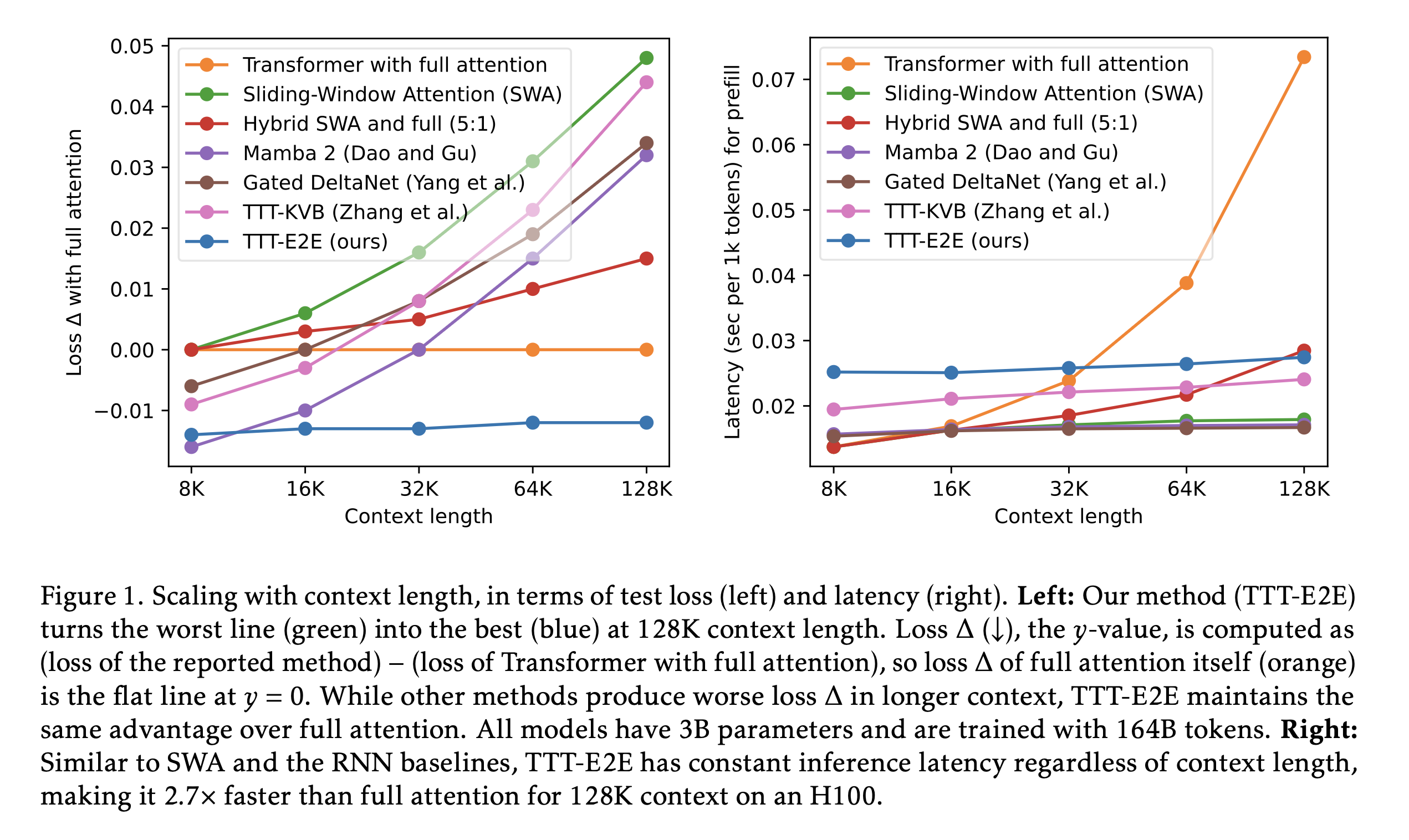
Goal: Formulate long-context language modeling as a continual learning problem rather than architecture design (e.g., building new types of Transformer caches or recurrent layers).
Problem statement
Self-attention requires linearly growing costs to process tokens because of nearly lossless recall.
- 🔑 Question: Can we train the model via next-token prediction at test time s.t. it can absorb information with only a constant cost per token?
Outline of paper
- Method: Mathematically + structurally defining TTT-E2E
- 2.1 and 2.2 (TTT & Meta-learning): Explains the inner loop (test-time training via next-token prediction) and the outer loop (optimizing base weights during training using gradients of gradients)
Architecture setup
Model is a standard transformer, with the following tweaks:
- Sliding window attention: instead of normal attention ( matrix relating every token to every other token), this model only ever attends to a recent window of words (e.g., the last 8000 tokens)
- Frozen weights: during test-time, the embedding matrices (words → numbers), normalization layers, and attention matrices are frozen.
- Fluid weights: the only weights that change during test-time are the MLP matrices in the last 1/4 of the transformer blocks
- Dual-MLP trick: to make sure the model doesn't "forget" its pre-trained knowledge while learning your prompt, put two MLPs in the final blocks:
- MLP1 is a static, frozen matrix containing long-term pre-trained knowledge
- MLP2 is a dynamic matrix that gets updated live
What happens at inference (test time)?
Imagine you give the model a massive 128,000-word prompt (e.g., a whole book). Here is what happens step-by-step in the TTT-E2E setup:
- Mini-batching the prompt: The model groups the prompt into "mini-batches" of tokens (e.g., chunks of 1000 tokens)
- ^(model does this instead of updating its weights after every single token)
- Forward pass ("practicing"): The model reads the first chunk of 1000 tokens. As it reads, it uses its initial base weights from pre-training () to "play a game": model tries to predict token 2 from token 1, token 3 from token 2, ...
- Inner-loop loss ("checking the answers"): The model checks its predictions against the actual (known!) next words in your prompt and calculates errors (cross-entropy loss)
- Weight update (compressing context): The model performs standard GD live on the prompt! It calculates the gradients and updates the dynamic MLP matrices in the last 1/4 of the network.
- Mathematically:
- Concretely speaking: The numbers in the fluid MLP matrices are altered! The context of those first 1000 words is now baked into the new weights ()
- Repeating ^ through the document: The model moves to the next chunk of 1000 words, using the new weights to predict the next tokens.
- ^ It calculates the error, takes another gradient step, and creates → do this sequentially until model reaches the end of your 128,000-word prompt.
- Generating the answer: Now that it has processed your entire prompt,
Notes from discussion
Full-attention takes time Amortized time -- at each token, use next-token loss as the way to get "context" into the weights of the model
Instead of doing weight updates for every token, batch it into tokens (mini-batch) and update the weights for every tokens. (Latency is kind of scuffed! )
Idea of using your training to match your use case is really cool!
2.1-2.3 (Deriving real method) 2.4 (Alternate derivation)
Highlighted sentence:
Our primary derivation starts from TTT via next-token prediction, which is E2E at test time, and focused on making it E2E at training time via meta-learning in Subsection 2.2. Our alternative derivation, on the other hand, starts from TTT-KVB, which is E2E at training time, and focused on making it E2E at test time via next-token prediction.
-
TTT-naive: single next-token prediction once at training time
- At testing time: go through the sequence, do a bunch of weight updates per prompt token, and then output the final output
- ^ there's a disconnect between how we are training the model (single next-token prediction) and how it is being used at inference (chained continual param update next-token prediction)!
- 🔑 Contribution of this paper: Make the loss at training time match that of test-time (inference)!
- Core concept: Make your training lost match your test time usage
-
⚠️ Skeptical of this paper ? Can't really parallelize training (so can't scale to 100s of billions of params)
- Is this a general issue with this type of approach to long-context models? DeltaNet also can't be parallelized
- Mamba2 has "state-space duality" (wdk what this is lol) but it can be parallelized
Long-context training for video models?
Drifting model = contrastive learning within a feature space